
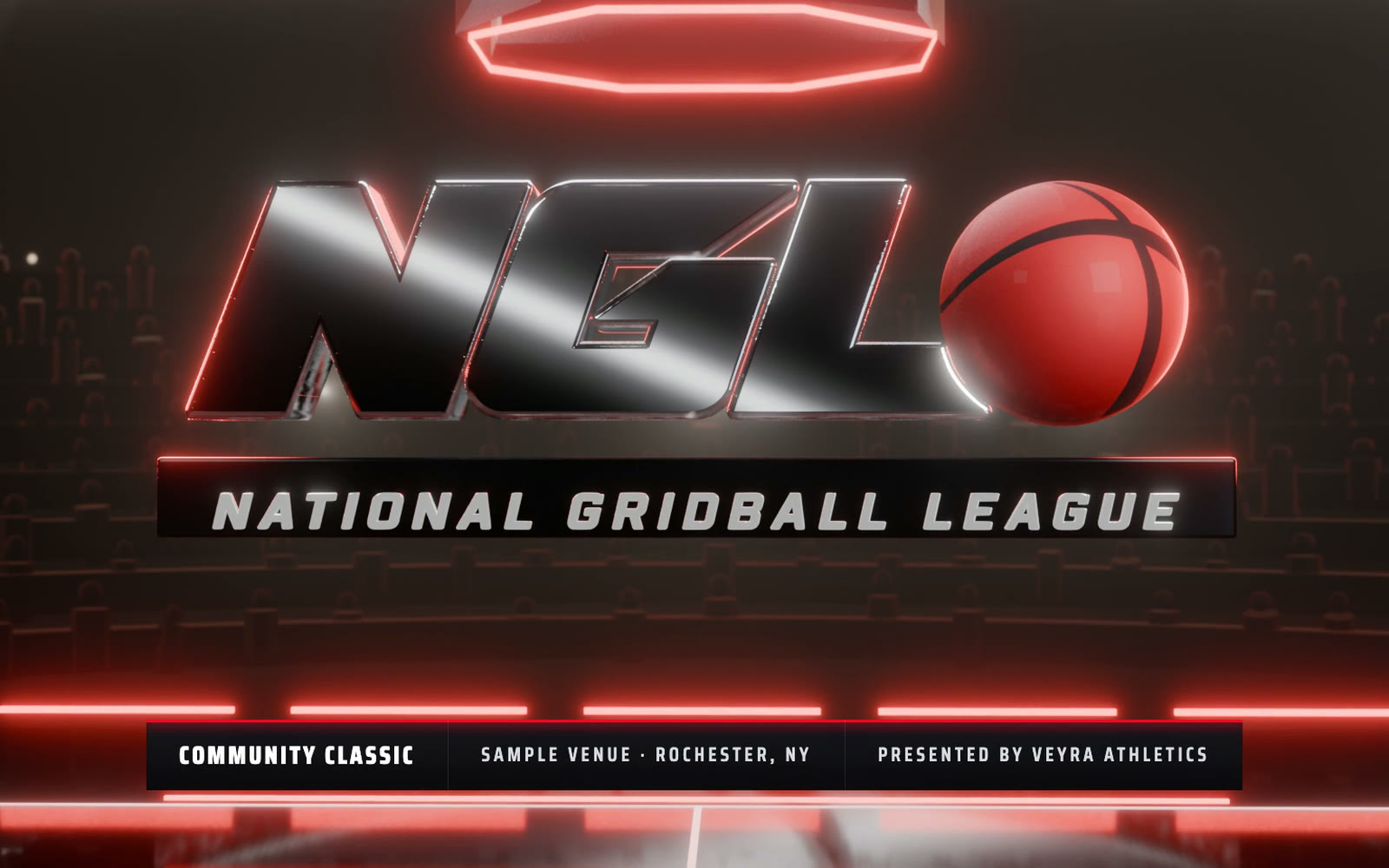
- The problem
- Every rule, tool and screen had to be decided before a single real match. There was no season to learn from, no players to ask and no scoreboard that understands the game.
- My approach
- Study how established sports and their vendors solve the same problem, test rules in a match simulator, and write the answers into software and the rulebook together.
- Where it stands
- Rules tested on thousands of simulated matches, a scoring console rebuilt after an audit, a broadcast system that runs in a gym, and a public site. Nothing has met real players yet.
Three decisions in this case study
- Make the big scores feel earned, like a touchdown.
- Make the score impossible to get wrong at the table.
- Make a sport nobody knows readable, in a gym.
The sport in one minute
Gridball grew out of boxball. At my Miami arts high school we played regular boxball in a seventh-floor dance studio every single day. It was our school’s sport. Gridball is my answer to a question that game left me with: what could it become if it were designed for competition, with teams, officials and a league? It’s still a concept, and playtesting comes next.
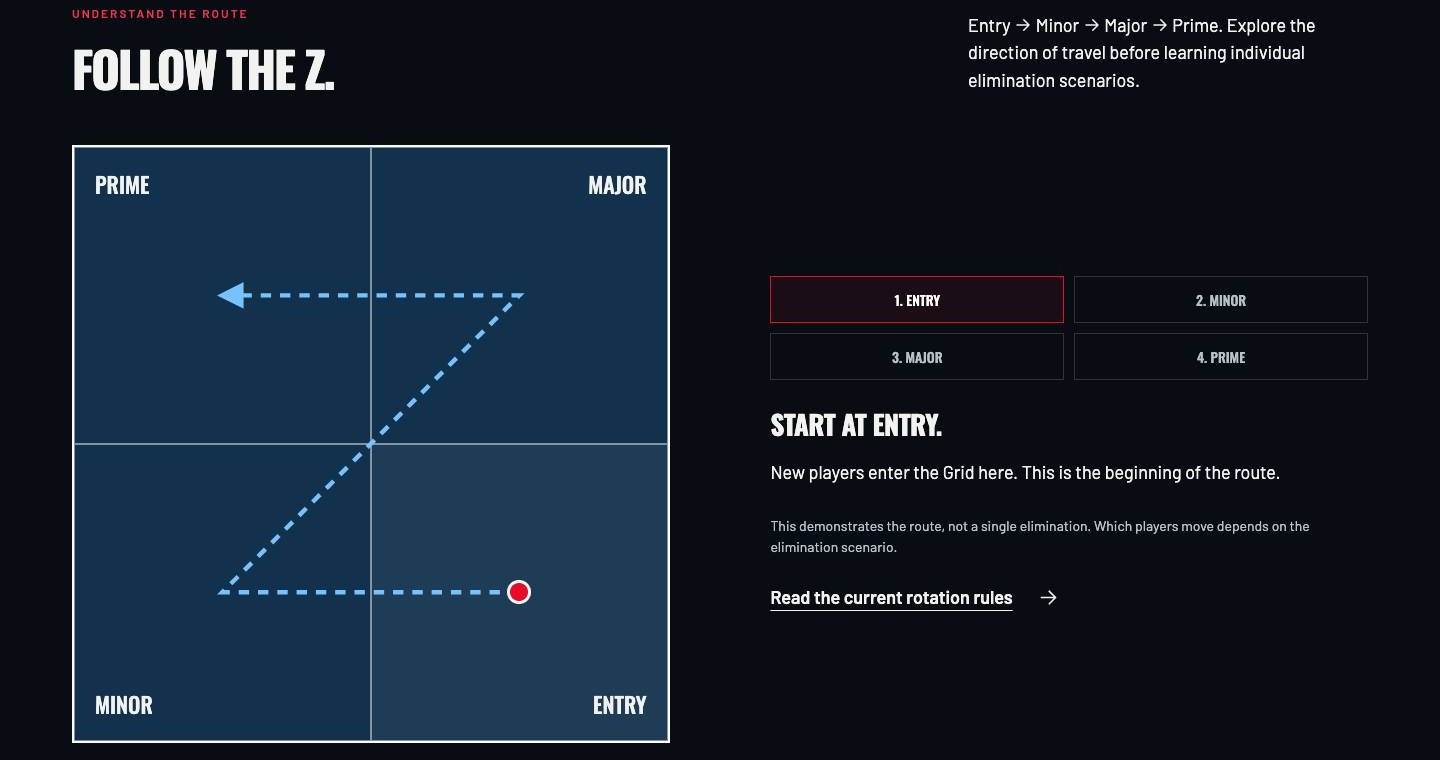
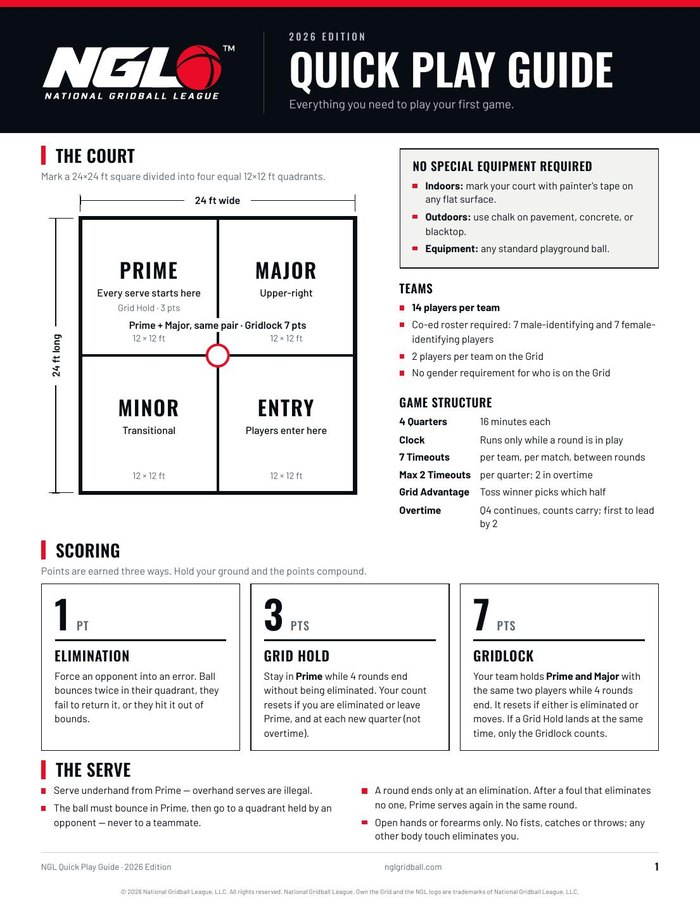
- The Grid. A 24-foot square of four equal quadrants: Prime, Major, Minor and Entry. Two teams, two players each on the Grid, from co-ed 14-player team sheets.
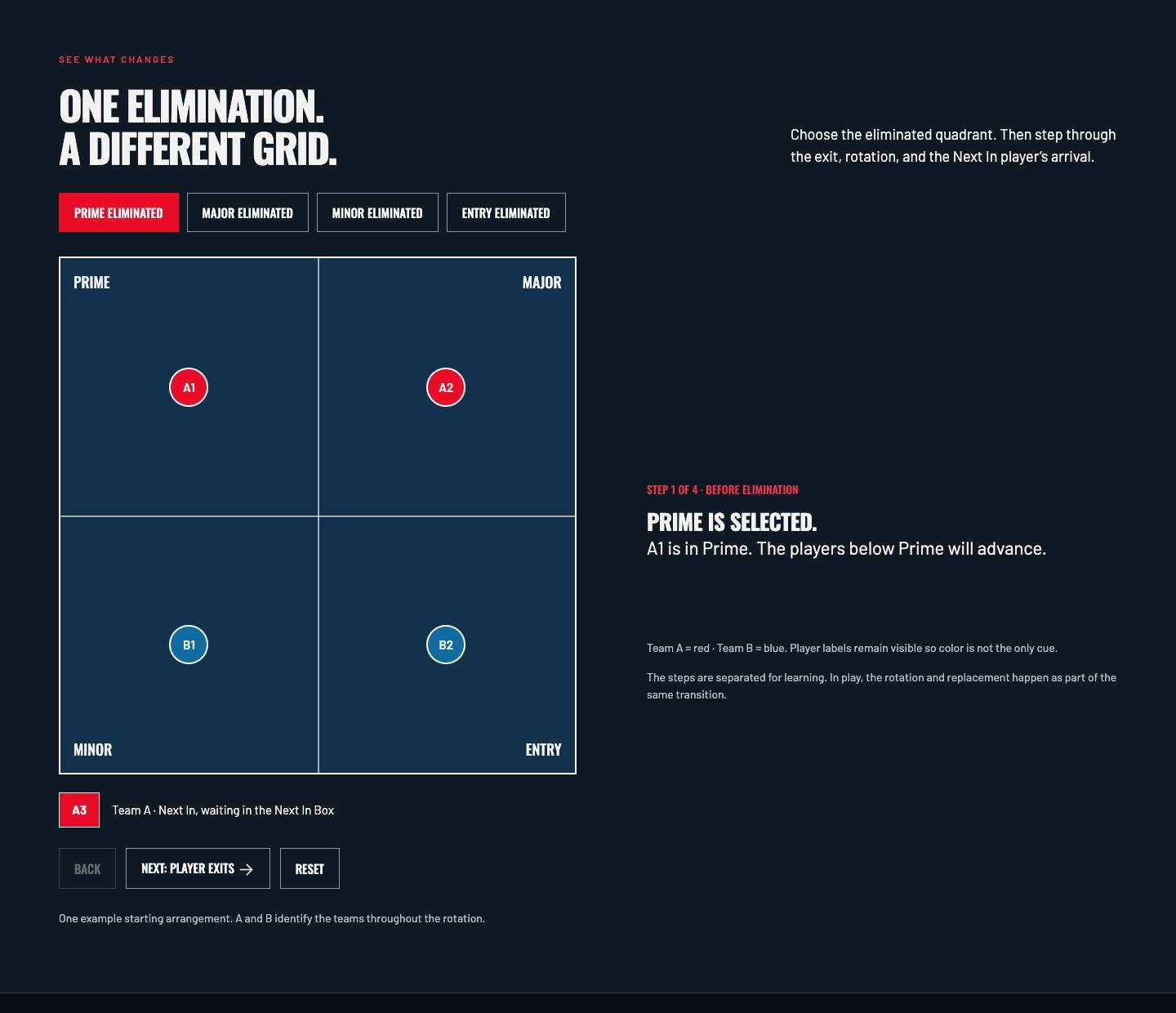
- The rally. Prime serves. Every return goes to another player’s quadrant after one bounce. Miss, and you’re eliminated.
- The Z. Players below the gap move up, Entry to Minor to Major to Prime, and a teammate comes in at Entry.
- Scoring. An elimination is 1. Holding the top of the Grid for four rounds earns the big scores, 3 and 7. Those are where the first decision begins.
Decision 1 · Rules
Making the big scores feel earned
A Gridlock is worth 7. I wanted it to feel like a touchdown or a three-pointer: rare, earned by a team, and something a crowd can see coming. Under the original rule, one player holding Prime for four straight rounds scored it.
A rule like that can’t be judged by reading it, so I built a match simulator to play it out. It runs full matches with elite rosters, coaches calling plays, Next In choices and timeouts, and scores every round with the console’s own code. No two matches are the same, and none are scripted. The first studies said the rule was broken:
Finding the cause
The tempting fix was to cap the award. I looked for the cause first. An audit of the simulated serve found a hard, fast drive with no bounce in Prime and almost no risk of a fault. It ended about three in ten rounds on its own, so Prime almost never lost. That isn’t a scoring problem. It’s a gameplay problem, and I set a rule for myself: fix how often the big scores happen through how the game is played, never through a technical patch on the score.
Options I weighed
What changed
I tested the new definitions on 300 matches in the updated model before they went into the rulebook.
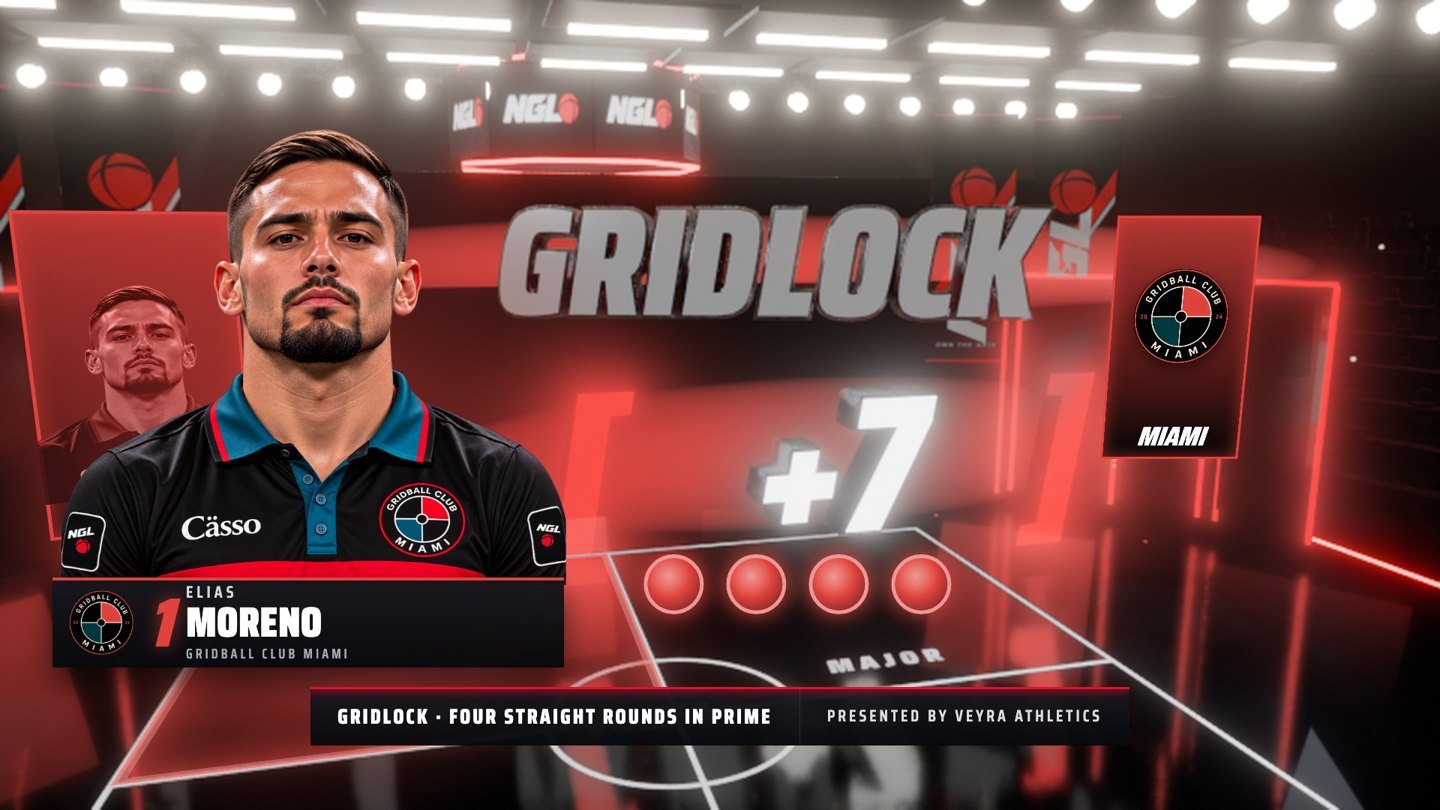
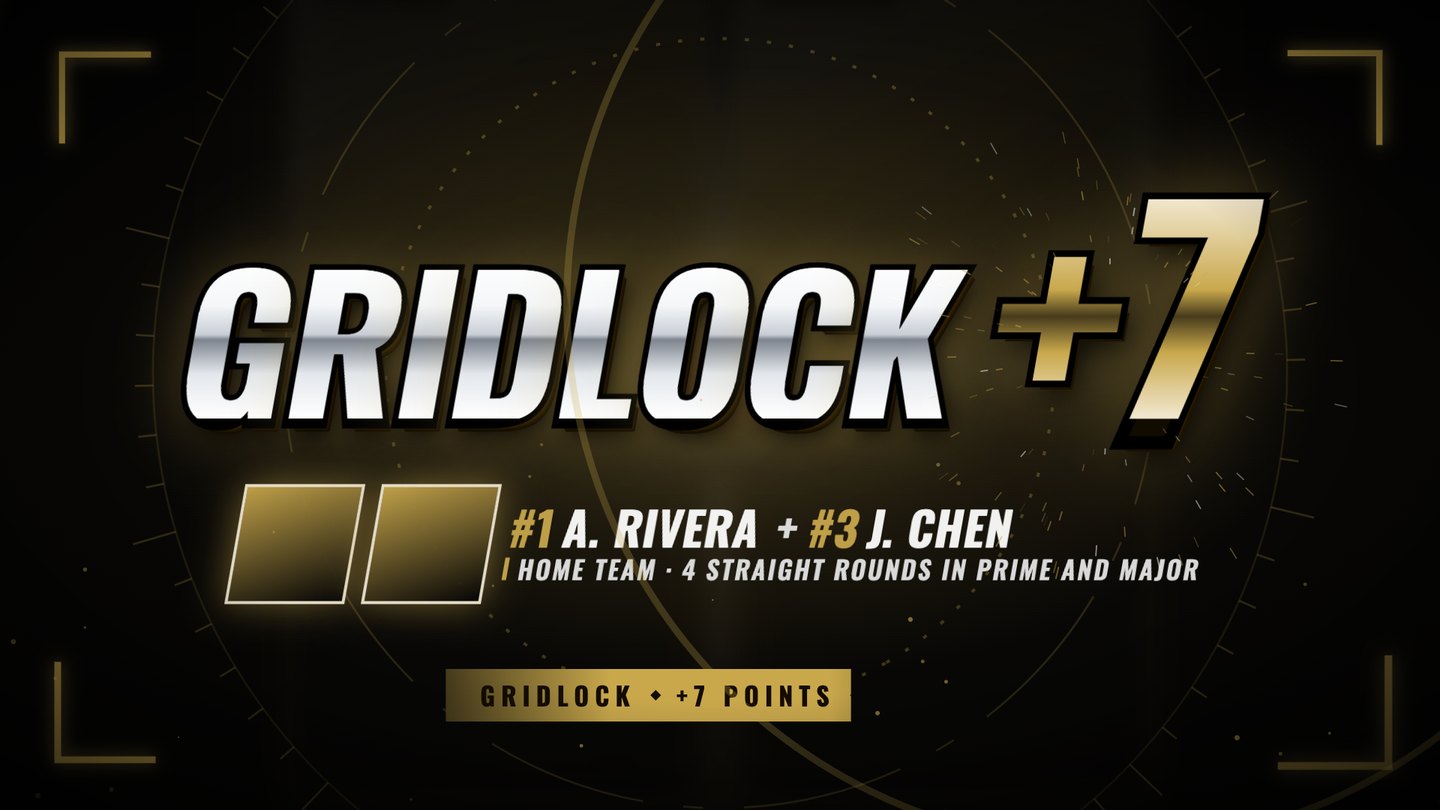
A rule change in a league touches everything. This one reached about 300 files across the website, the scoring console, the mobile app, the printed books and the simulator. I wrote one specification, recorded thirteen follow-up rulings it raised, and tracked every file against it. It shipped to the site, the console and the app on November 2, 2026. The graphics changed too: the Gridlock takeover now shows the pair that earned it.
Decision 2 · Console
A console that can’t get the score wrong
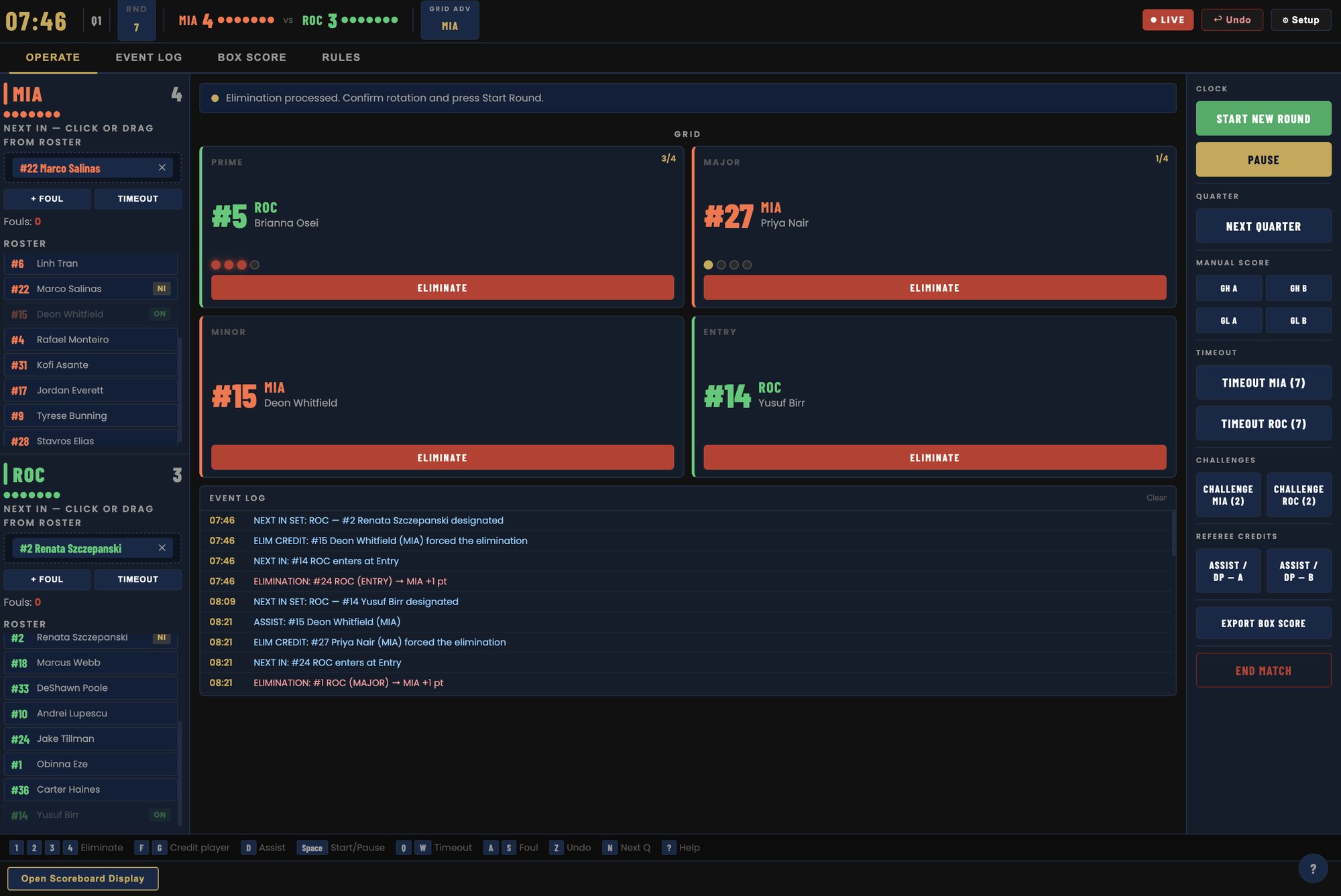
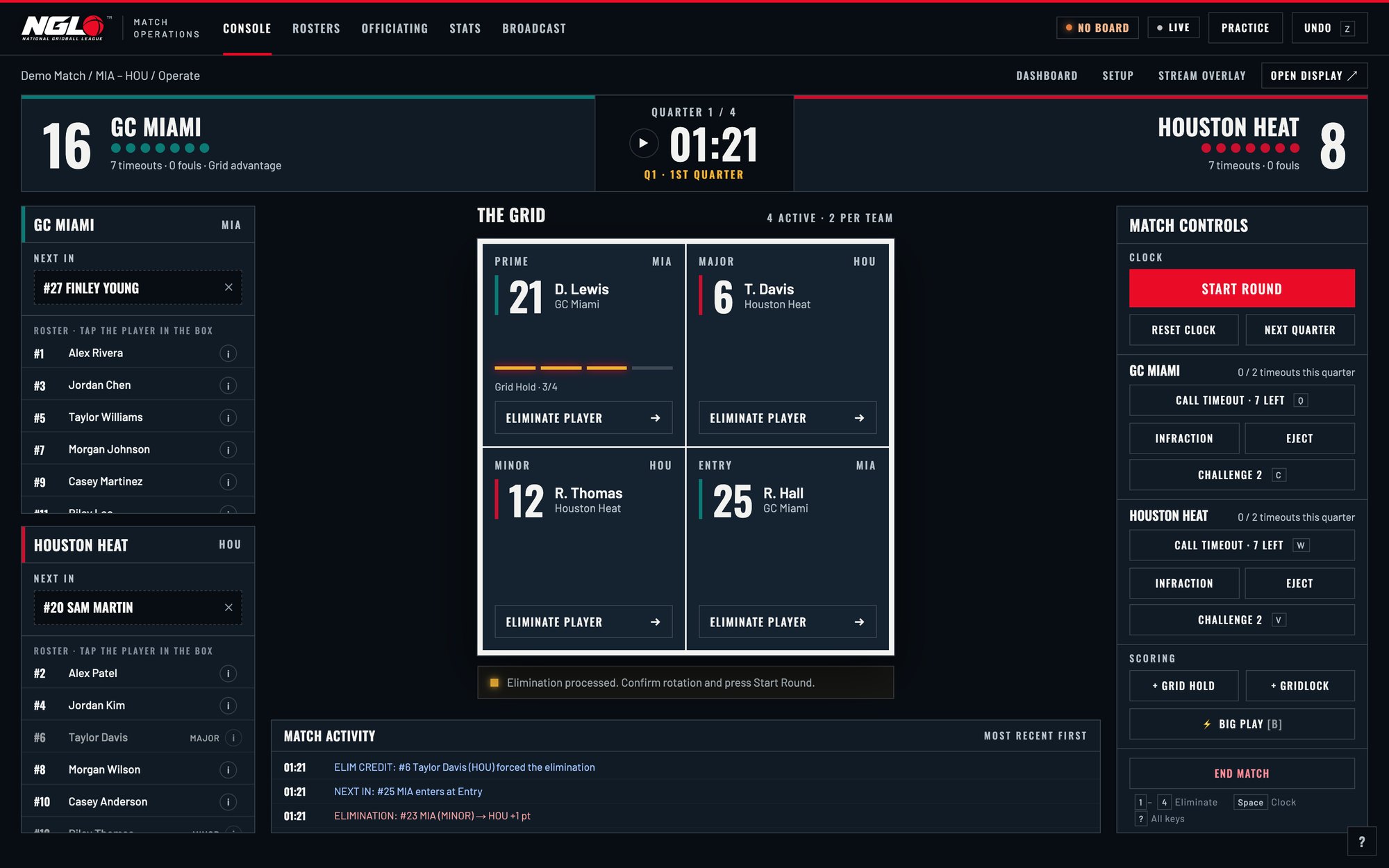
No scoreboard on the market understands Z rotation or the Grid’s awards, so I built one. The person using it sits at a folding table in a school gym, scoring live on a laptop or iPad while a crowd watches the display it drives. One wrong tap changes a result.
The first version, from March 2026, worked in demos. Before trusting it with a real match, I had it audited against how professional scoreboard consoles work. The Daktronics All Sport 5000, a standard in gyms, sets clear conventions: separate start and stop controls, a visible running indicator, confirmation before editing a stopped clock, and recovering the previous game after a power cut. The audit, run by an AI agent against the code, reproduced five serious defects:
- Undo could leave the clock showing as running with nothing timing it.
- Points scored in practice mode carried into the live match.
- Eliminations could be recorded before the match started.
- Pausing and resuming counted a second round.
- The same player could stand in two quadrants at once.
Rulings the design couldn’t make
Some of the bugs were really unanswered rules. When does a round end? What happens if the clock runs out mid-rally? Those can’t be settled by a screen layout, so I ruled on them as Commissioner and updated the rulebook to match:
- A round ends only at an elimination.
- If the clock runs out mid-rally, the rally finishes.
- Timeouts happen only between rounds.
- A penalty elimination uses the normal rotation, and an ejected player leaves the Grid and can’t return.
What I changed
- A layout built on the conventions. A match strip that always shows the score, the clock and whether it’s running. The Grid in the center, matching the official diagram. Next In beside each team. A control rail where pausing can never start a new rally. Practice runs as its own session.
- Every action is an event. An append-only log, so undo, corrections and the final record all come from the same history.
- It survives a crash. A live match recovers on reload.
- The display has to answer. The board acknowledges each update, and the console warns the operator when the display falls behind or drops off.
- Tests before every change. The scoring engine has 122 automated tests that run before any change ships.
Decision 3 · Screens
Readable in a gym, for people who’ve never seen it
Nobody watching a first match will know the rules. And no Gridball arena exists. Early matches will be in school gyms and rec centers, on a taped court, with a TV or a projector as the display. So the screens have to teach the game as it happens, on hardware the venue already has.
I looked at how a newer pro sport handles this. Major League Pickleball’s venue screens put big scores, team crests and player names on a dark field. Scoreboard vendors keep the scoring software separate from the display software. My first arena display, from March, read like a web page that happened to be on a big screen.
The arena display
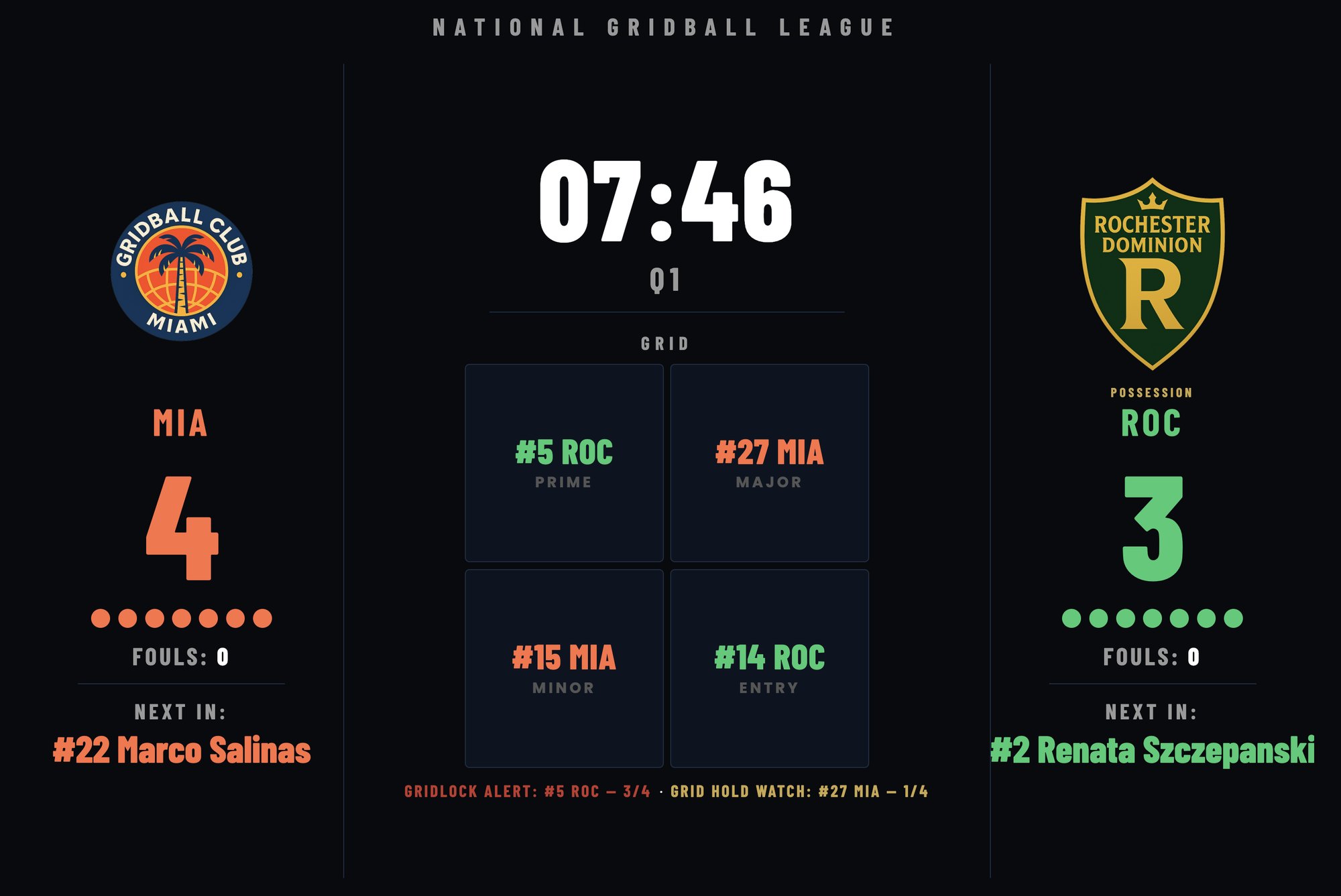
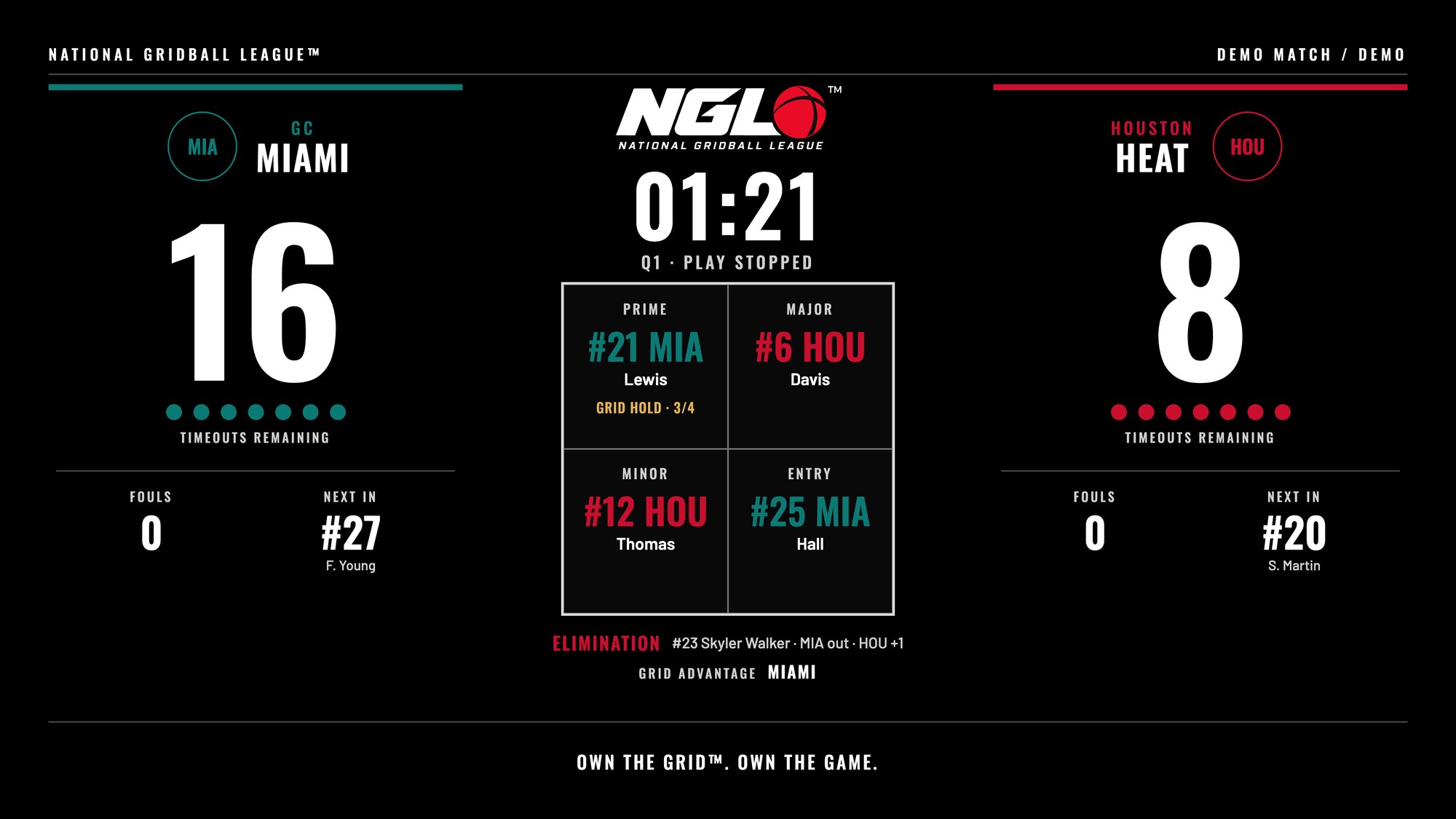
- A fixed 16:9 canvas. It scales evenly to any TV or projector, with nothing that scrolls or rearranges.
- Score and time first, the Grid second, everything else third. The square Grid stays in the center, with the league logo above the clock.
- Show what’s at stake. The hold count sits in the Prime cell, so the crowd sees a big score coming before it lands.
The broadcast
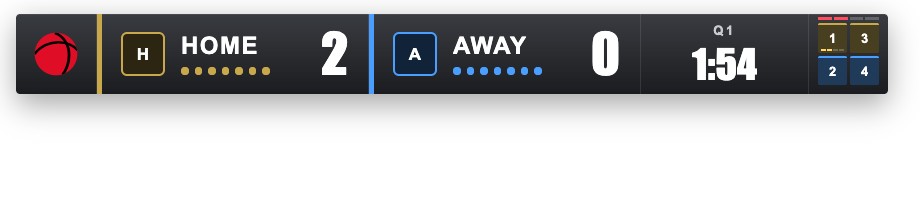
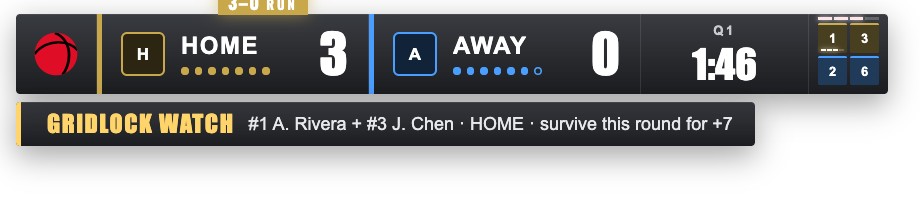
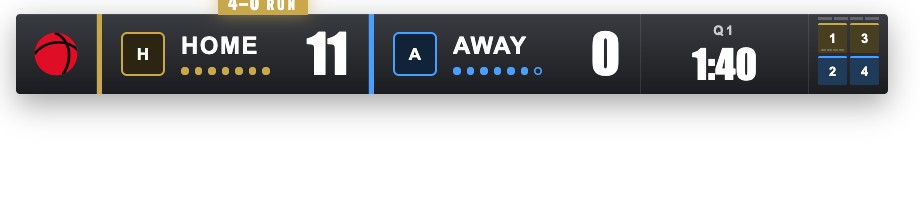
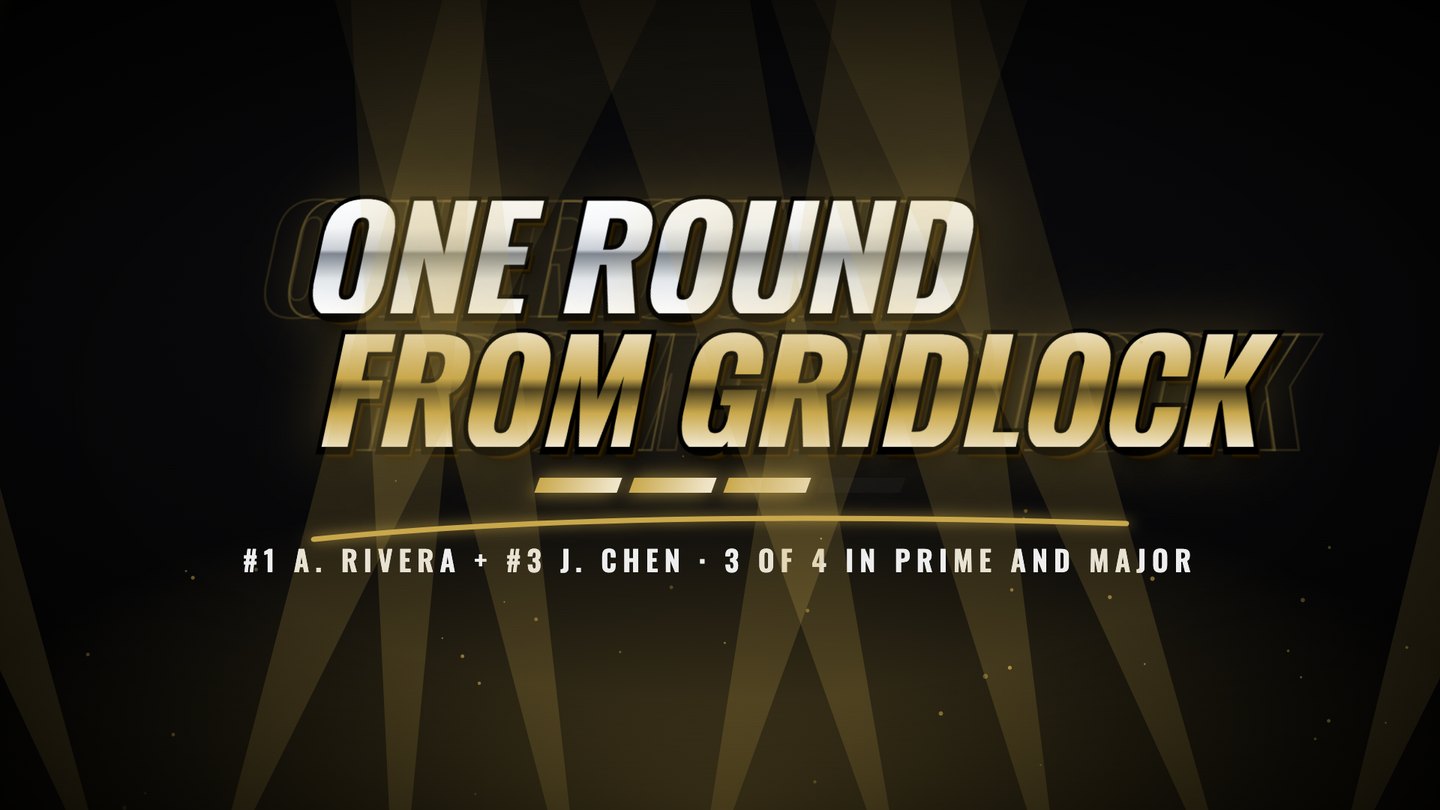
- Build the moment before it lands. The score bug tracks the pair’s Gridlock count, calls a Gridlock watch at three of four, then scores it. The arena gets its own “one round from Gridlock” moment.
- Graphics from the event log. Graphics fire from what actually happened at the table. The arena display shows every moment; the stream shows only the big plays, one at a time.
- A producer can’t change the score. Graphics run on their own feed, separate from scoring. In testing, forged score updates from the graphics side were refused everywhere.
- It works without internet. Gyms don’t promise Wi-Fi that works, so the console, the producer app and the stream overlay can link over the venue’s local network with a pairing code.
- Sponsors get proof. The console logs every second a sponsor is on air, counting only while a screen confirms it’s receiving, and exports a report per sponsor.
- One identity. One league typeface from the website to the on-air graphics, and color from the NGL brand and each club’s own colors, not a different color for each kind of score.
The rest of the league
A league is mostly logistics. I designed the back office around each role’s actual day: a competition wizard for seasons and tournaments, a schedule board the Commissioner publishes from, roster checks, and a match day flow with check-in, a go/no-go and a final sign-off at the table. Results flow from the console into public pages for fixtures and standings.
Officials can’t work from a website, so every rule change also rebuilds the printed books together, and they never disagree.
What isn’t proven yet
- No real match has been played. The simulator’s players are a model. How often Prime survives a round is still an assumption until real players show otherwise.
- The clock is still open. In the model, a clock that runs only during rallies stretches a match to between three and five hours. A running clock brings it to about 80 minutes. The playtest will decide.
- No real operator yet. The console has never run a live match with a crowd watching.
- Screens in a real room. Projector readability at viewing distance, and the cloud broadcast path, still need testing in a venue.
The first playtest will measure the rally, the rotation and the scoring with real players. Then I’ll recalibrate the simulator, rerun the studies, and see whether V3.9 holds.
What I learned
Designing a sport is designing a system, and every part leans on another. One scoring rule changed the console, the graphics, the books and the stats at once. The simulator let me argue with my own rules using evidence instead of instinct, while they were still cheap to change. Looking for the cause before the fix mattered most: the serve fix did more than any cap would have. And some design problems were really rules nobody had written yet. Once I answered those as Commissioner, the screens got simpler.
Numbers come from my match simulator. Clubs, players, arenas and sponsors shown are concepts or fictional. Console and display captures are demo matches.